
Your to-do list is destroying your productivity, and Nir Eyal has the research to prove it. In this episode, Igor sits down with the bestselling author of Hooked, Indistractable, and Beyond Belief to dig into why 90% of distraction has nothing to do with technology, why time boxing beats every to-do list ever created, and why the most dangerous thing an entrepreneur can believe is that they can’t.
Guest:
Nir Eyal is the bestselling author of Hooked, Indistractable, and Beyond Belief. His work has been published in Harvard Business Review, The Atlantic, TechCrunch, and Psychology Today. He is one of the few researchers who understands both sides of the attention economy: how to build products that form habits and how to help people reclaim control over their own. His newest book, Beyond Belief, argues that our beliefs are not fixed truths but flexible tools we can redesign when they stop working for us.
[00:53] The Real Source of Distraction and Why Technology Gets Too Much Credit:
- Traction and distraction are opposites. Traction is any action that moves you toward what you said you would do. Distraction is any action that moves you away from it.
- Only 10% of distractions come from external triggers: pings, dings, notifications, anything in the outside environment. The other 90% come from internal triggers.
- Internal triggers are uncomfortable emotional states: boredom, loneliness, fatigue, uncertainty, anxiety. That is where 90% of distraction actually begins.
- Plato wrote about this 2,500 years ago. He called it akrasia, the tendency to act against our better interest. Distraction is not a product of the iPhone. It is a product of being human.
- Blaming technology is not going to solve the problem. And using the word dopamine as if we understand what it does is reinforcing a belief that we are powerless, which guarantees we will act powerless.
[05:43] Four Steps to Becoming Indistractable:
- Step one: master internal triggers. When you feel fatigued, anxious, or uncertain, you need a practice in place for what you will do with that sensation and what you believe about it. The nocebo effect is real. Telling yourself you had a bad night’s sleep, whether or not it’s true, will make you perform worse. Your limits are often the limits of your beliefs, not your physiology.
- Step two: make time for traction. A to-do list with no time constraints is not a plan. It is a wish list. Time boxing, scheduling everything down to the minute, including leisure, video games, and rest, is the most well-studied and validated time management technique in existence.
- Step three: hack back external triggers. Even though they only account for 10% of distractions, unnecessary emails, pointless meetings, and notification pings can still knock you off track. Eliminate everyone you can.
- Step four: make a pact. Decide in advance what you will do when you are likely to get distracted. A pre-commitment made before the moment of temptation is far more powerful than willpower in the moment.
- Use all four in concert, and anyone can become indistractable.
[13:13] Why Email Is the Cockroach of the Tech World and How to Stop Abusing It:
- Email is the mother of habit-forming technology. It has been around longer than the web browser, and it refuses to die. It uses the hook model perfectly, which is why we keep coming back.
- The worst thing we do with email is use it as an emotional pacifier. When we don’t know what to do, or don’t want to do what we know we should, we check email because it feels productive without requiring real thought.
- Your job is not to check email. Your job is to get things done. Email should never be the thing that tells you what to do with your day.
- Stop checking email 40 times a day. Put it on your calendar. Decide in advance how many times you will check it and for how long. Two hours a day of focused email time is more than enough for most people.
- The goal of time boxing is not to finish the task. It is to learn how long things actually take and to stop confetti-ing your time across a hundred half-started things.
[16:24] Why To-Do Lists Are One of the Worst Things You Can Do for Your Productivity:
- To-do lists have no constraints. You can always add more. That means they are not a register of things to do but a list of things you wish you would have done.
- Coming home at the end of a long day to a to-do list still full of unchecked items is a daily psychological message that you are a failure. Day after day, week after week.
- People then assume they have ADHD or poor time management. The reality is they are using a terrible technique. If there is no time for it on your schedule, you were never going to do it.
- A time box calendar forces you to be realistic. You have eight hours. Here is what fits. Here is what does not. That constraint is not a limitation. It is clarity.
- The biggest benefit of time boxing is that you learn how long things actually take, which is a feedback loop a to-do list can never give you.
[20:13] Turn Your Values Into Time — The Most Important Thing in This Episode:
- Values are attributes of the person you want to become. Not abstract ideals. Attributes. And you reveal your values through how you spend your time and your money.
- Money is renewable. Time is not. We are stingy with money and reckless with time, which is exactly backwards.
- The three life domains: yourself, your relationships, and your work. All three need to be in the calendar. If your relationships are not scheduled, they will bear the brunt of your poor planning.
- Reflective work, the kind of thinking, planning, and strategizing that can only happen without distraction, must be scheduled. Nobody else is doing it. If you do it, you have a leg up on everyone in your industry.
- When you turn your values into time, you will quickly realize you cannot have everything at once. That is not a problem. That is the point. Make the trade-offs consciously and in advance instead of by default at the end of your life.
[33:36] The Most Destructive Belief and the Most Powerful One:
- Entrepreneurial alertness, the ability to see opportunities that other people cannot, is a function of belief. Lucky people and unlucky people given the same newspaper completed the same task in 11 seconds versus two and a half minutes. The difference was a bold-print message on page two that said there are 43 images, collect your reward. The unlucky people counted the image. They never read what it said.
- The most cancerous belief an entrepreneur can have is that they cannot. The most powerful is that they can.
- Persistence is the number one trait of people who achieve long-term goals. Not intelligence, not skill, not resources. Whether or not you quit. Quitting guarantees failure. Persistence does not guarantee success but it is the only path to it.
- Two identical marathon runners. Same bodies, same training, same everything. One believes he can finish. One believes he cannot. The outcome is not even a debate.
- A belief is not a fixed truth. It is a conviction open to revision based on new evidence. Most of what we act on day to day is not objective fact. It is a prediction. And predictions can be updated.
[40:36] Rapid Fire Questions:
- Where to start with Nir’s books? Read Beyond Belief first. It is the unlock code that makes all other self-help advice actually usable. Then Indistractable. Then Hooked if you are building habit-forming products.
- Are we living in the matrix? No evidence of robot aliens. Very strong evidence that we live in a simulation of our own minds. The brain cannot process all available reality so it builds a filtered prediction based on existing beliefs. We see reality as we believe it to be, not as it is.
- Best advice for parents? Use mimetic desire. When your child sees another person wanting something, they want it too. Natural consequences and visible examples are far more powerful than lectures.
[41:43] Nir Eyal’s Expertise:
- Nir Eyal’s Books
- Hooked
- Indistractable
- Beyond Belief
- Website: nirandfar.com
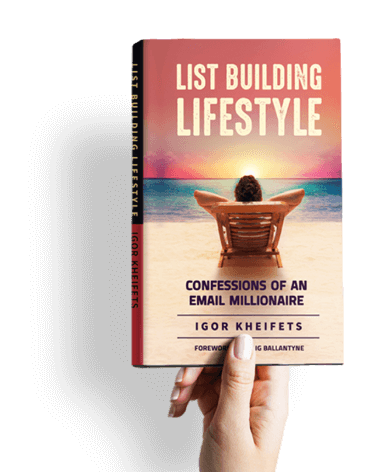
Get Igor’s Free Book — List Building Lifestyle: Confessions of an Email Millionaire
A great book for anyone who wants to build a responsive email list, create sales without relying on social media, and grow an online business with more leverage, freedom, and control. Inside, Igor breaks down the list-building and email marketing strategies that helped him turn email into a scalable income stream.
You’ll also get access to a full bonus package with templates, swipe files, and traffic strategies used to build and monetize lists fast.
Visit: www.igorsbook.com