
Five years ago, Igor sat down to make a list of things he used to believe about this business that he no longer agrees with. He came up with nothing. In this episode, that exercise opens up into something much bigger. Why the fundamentals of marketing have not changed across centuries, why most of what we buy is decided emotionally and justified logically, and why the arrival of AI agents will not change human psychology so much as just remove the ambiguity from it.
[00:52] Nothing I Believed Five Years Ago Has Stopped Being True:
- Igor set out to list the things he used to believe about his business that he no longer agrees with. He came up with nothing. Not one item.
- The opposite exercise produced 15 items in the first five minutes: things he believed five years ago, even ten years ago, that are as true today or truer.
- The technology changes. What influences us to buy, how we make decisions, and whether we choose to trust a brand or a solution does not change at all.
- 22nd-century principles of marketing do not differ very much from 21st-century principles, which do not differ very much from 20th-century principles.
- The fundamentals are not a trend. They are a constant.
[02:44] Why School Trains Us for the Wrong Kind of Problems:
- Rory Sutherland’s book Alchemy makes a sharp observation: school teaches us to solve narrow problems in narrow contexts, where there is exactly one right answer.
- A bus leaving a station heading north at 60 miles per hour. A bike heading west at 50. In how many hours will they have collectively traveled 500 miles? One answer. That’s school.
- Most of life’s problems are wide context problems with multiple right answers, almost infinite variables, and half the variables unknown.
- Getting from New York to JFK: do you take a cab, the train, or the bus? The answer is it depends. It depends on your luggage, your budget, your luxury preferences, the traffic, whether the train is under construction, and what time you want to wake up.
- Marketing is a wide context problem. And the right answer for one person is completely wrong for another.
[06:19] Why Marketing Is a Wide Context Problem and Always Will Be:
- Prospects making purchasing decisions are not running a narrow calculation. They are computing across a wide range of known and unknown criteria simultaneously.
- People make emotional decisions and justify those decisions with logic. The decision to buy is emotional, of which fact they are completely unaware.
- Great marketers like Rory Sutherland and David Ogilvy are able to uncover the invisible emotional reasons why people buy, the reasons buyers themselves could not articulate.
- If purchasing was purely about cost, the cheapest product would always win. If it was purely about reliability, the most reliable brand would always win. Neither is true because it is never that simple.
- Igor has launched promotions he would never have bought himself that generated dozens of sales, and launched things he was personally excited about that completely flopped. The unknowns are real and they are many.
[11:20] What Happens When the AI Agents Do the Shopping:
- The economy may eventually become one where a person’s AI agent browses the internet and transacts with a business’s AI agent, two robots communicating to complete a purchase.
- Even in that scenario, the AI agents would still make decisions based on the criteria the humans give them. The human values and preferences do not disappear. They just get delegated.
- In an AI-to-AI economy, the deciding factors would likely boil down to social proof, authority, and cost effectiveness. Which are the same principles Robert Cialdini described in Influence decades ago.
- The magic gets taken out of it. The ambiguity shrinks. But the underlying principles remain unchanged.
- The principles did not change in the 20th century. They did not change in the 21st. They will not change in the 22nd.
Get Paid $100–$500 Without Selling Anything You Own
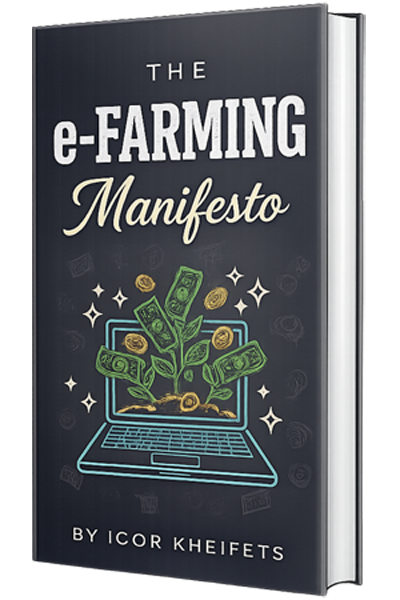
There’s a simple money-making strategy being used on you every single day without you noticing. Once you see it, you can’t unsee it. In his new short book, Igor breaks it down start to finish: how he uses it to collect finder’s fees of $100, $250, even $500 without creating a product, handling customer service, or shipping a single thing.
The book is normally $24.95. Use code SHIP4FREE to get a copy shipped to your doorstep for just $9.99.
Visit: https://efarming.com/manifesto/